Monday, August 25, 2014

Rethinking Aid: Perspectives from a Mzungu in Mumias

For the most part, the experience of being a white female in Mumias was  rewarding and moving. Everyone we met was kinder than I could begin to express in this blog post. They shook our hands hello and goodbye with endearing smiles, often welcomed us with a song and dance, offered up their chairs in claustrophobic little rooms during torrential downpours, served us tea and fried bread to quench our thirst (despite the humid, unbearable heat), and ALWAYS made sure we were “shiba”ed, or full. Each of these experiences was heartwarming and charming, as it was evident that our hosts wanted nothing more than to make us feel at home, comfortable and loved in our temporary home. 

However, there were some times that my race made me feel uncomfortable and sometimes even bitter about the place of privilege that I’m from. While it is touching that someone would feel so blessed to have me in their home, a part of me wishes these feelings didn’t exist at all. They imply a difference between us – that I am in some way better than them. In one conversation with Edwin he said “you, when you are visiting a support group, you have reduced the stigma to zero.” While for Edwin, this simple fact of bringing a white person to his field visits brings him pride, this makes me uncomfortable and even angry. Why should my simple presence at a support group be so powerful that I have eliminated any sense of stigma? Why should my acceptance or acknowledgment of a group of people make them feel respected? 

I chose to travel to Mumias to do grassroots global health work and I’m so thankful to have the opportunity to make a difference somewhere I was needed. As interns this summer, we were able to find valuable data through the countless hours we spent  interviewing beneficiaries of WOPLAH’s projects; we were able to be of technical assistance to Edwin and his team by updating their website, training them on social media skills and connecting them with potential partners and donors; and we created a new Partner Action Framework that will guide the allocation of around $10,000 worth of funds from GlobeMed at CC. I am so thankful, and I also know that WOPLAH’s team is so appreciative for the work we have been able to do this summer that will also carry on into the coming year. 

However, I can’t help but think about the fact that a good majority of WOPLAH’s projects would not exist without GlobeMed at CC’s funding. And I cannot help but resent that by traveling to Mumias, Kenya I provided something that the community otherwise would not have. I find myself asking questions like: “is my act of traveling to Mumias to do grassroots work only exacerbating the evident disparities in the world by reinforcing my privilege?” and “Is GlobeMed’s partner model creating empowerment or is it causing dependency in the long-run?”  I know, and have witnessed first-hand, that many of WOPLAH’s projects are on their way to becoming self-sustainable and in the future they will no longer need outside funding, but will continue to reduce stigma and improve the livelihoods of people living with HIV/AIDS through their own capacity. I also know that several of GlobeMed’s other chapters have moved on to new partners because their previous partners have become self-sufficient and no longer needed their funding. This makes me hopeful about the future of the work we are doing, and I feel it is important to continue asking these questions about privilege, dependency, and status so as to constantly and critically rethink how we engage as members of the global community. I hope that asking these questions will require me to keep moving deliberately down this path of global health I find myself entering as a recent grad rather than becoming stagnant in fear of acting on the privilege I come from. 


Saturday, August 23, 2014

Africa Yoga Project


I have known about a non-profit called Africa Yoga project for a while now, so I decided to make a little stop in Nairobi after my internship to see what its all about - after all, I was dying to do yoga after months of a sporadic self-spractice.

On Saturdays at 10am they have a free community class followed by a vegetarian lunch. The Shine Center, Africa Yoga Project's studio, is located in the Parklands district of Nairobi which is inhabited mostly by Indians. I walked into a large building called Diamond plaza with several stories of shops selling saris, electronic accessories and other Indian trinkets. After asking for directions a few times, I found the Shine Center nestled in a corner on the fourth floor. At a quarter to 10, the studio was already busy with people signing in and finding their mats. I was delighted to see people of all nationalities - Asian, Caucasian, African and Indian - and there were also many kids!! Apparently, they have a special space for kids to practice upstairs during the community class. I've never seen that before, and I think its such a great idea! So many little aspiring yogis. 

Today's community class was dedicated to B.K.S Iyengar in celebration of his recent passing, so AYP brought in a guest teacher to lead an Iyengar style class. This class was different than what I'm used to; the teacher focused on proper alignment, and although we also pay attention to alignment in power yoga, in this class we repeated triangle pose three times, for example, attempting to perfect it by the third try. The teacher was strict and did not talk in a soothing or meditative "yoga voice". It reminded me a bit of Bikram yoga which also emphasizes fully entering a posture and uses strict tones rather then focusing on one's personal best. It was tiring holding postures for so long, and I missed the flow aspect that draws me so much to Vinyasa yoga. 

However, I enjoy trying new types of yoga and what made this class special and energizing was the community vibe that permeated the whole room. Our mats were lined up side by side with but an inch of space between them in order to accommodate the approximate 200 yogis who showed up to practice. People were gathered in small groups chatting before class contrasting the unspoken silence which is expected prior to most yoga classes. When the teacher would finally allow us to come out of a posture, the entire room would let out a huge sigh followed by a wave of laughter. Although sometimes I enjoy utilizing the yoga studio as a quiet, personal space of refuge, today's class was refreshing and allowed me to feel connected with the entire room full of yogis despite being in Africa and not having attended a class for 3 months. This is truly why yoga is so powerful. Checkout AYP's website (http://www.africayogaproject.org/), they're doing awesome things in and around Nairobi! I hope I can make it back here someday!

Tuesday, August 19, 2014

Reflecting on Religion in Mumias

Since our arrival in Mumias, I have been surprised by the attitude of religious tolerance that all Kenyans seem to uphold; even against my own inclinations towards religious tolerance, I have been waiting for some kind of indication of religious conflict of any kind. However, my expectations have been shot down. 

Anytime we visit a support group or someone’s house, we begin and end with a prayer led by one of the hosts. This wasn’t a surprise to me, as growing up we often said prayers during large family dinners or when guests would come over. To me, both in Kenya and the United States, it seems like a (mostly) universally accepted way of giving thanks for both parties’ ability to be together in the same room sharing a meal or an experience. However, what was surprising to me was finding out that often we are among a mix of religious beliefs. The Ambassadors of Hope (WOPLAH’s directors) are a mix of Muslims and various Christian denominations. Each time we have met with them a different person has volunteered to pray on behalf of the group. I love that, even though each individual is aware to some degree of the differences between their respective beliefs, they accept the prayer without hesitation or judgement. I don’t know whether they assume they all believe in the same God, or whether this is a moot point and any prayer to any God serves the same purpose: giving thanks and appreciation for the ability to gather, work towards common goals or eat good food. 

We have gone to church three different Sundays now – two Anglican churches and a Pentecostal church. Each service and physical church building has been unique in their own ways. One building had stained glass windows, two had pews to sit in, some had more elaborate altars. This past Sunday, the Pentecostal service, took place in a commonplace looking building with very few windows (and terrible circulation I might add). The atmosphere upon walking in was much different than both Anglican churches which both had an aura of peacefulness and refuge from the chaos of daily life. This church had a certain energy to it; it was packed full, men sat in rows on the left side and women sat in rows on the right side. The moment we entered, ushers walked up to us and quickly directed us to our seats. We didn’t seem to cause as much commotion as normal; a few people turned their heads to look at us but it seemed as though the greater majority were engrossed in the sermon which was loudly projected from the single speaker in the back left corner. The pastor didn’t seem to understand that using a microphone entails not needing to yell for people to hear you. The service consisted of a long and drawn out sermon, interrupted by people who would stand to interject a comment or question which the pastor would in turn respond to. There was also a lot of standing and singing with arms raised, a few women prostrated on the ground keeping their heads down throughout the entire song. One woman in the row ahead of us all of a sudden fainted and the people around her had to carefully break her fall and move chairs out of the way; somehow she managed to land on her her arm, preventing her head from hitting the floor. She lied there until the singing ended. No one acted concerned, and she eventually stood back up and continued on as if nothing had happened. 

The strange thing about this experience was that no one explained to us what was happening at any given moment. Even though the entire 3 hours was almost completely communicated in Swahili and there were several instances that, to me, seemed to require an explanation, we were simply expected to sit patiently through the service. 

The more interesting thing about attending church in Mumias is the free-will with which Edwin and the others who have hosted us move between churches and denominations. My initial reactions to the tolerant attitude toward prayer seemed to be reaffirmed through our visits to various churches. Differences in faith seem to be trivial, while the acts of gathering and praying appear to be what is truly important among religious individuals in Mumias. 

Stay tuned for my upcoming blog about my experience attending a Muslim women's prayer group and my observations regarding religion and global health in Mumias!
 

Saturday, August 9, 2014

Kangas, the Rainforest and Yoga!

This week Edwin rewarded us with some lovely days off to catch up on projects for WOPLAH, explore surrounding Mumias and spend a little time outside of the familiarity of our compound. So what did we do? We travelled to Uganda to buy kangas, took a sunrise hike through the rain forest and did some yoga… taught by me!

On Tuesday, our mama Gladys accompanied us on a 2 hour, cramped bus ride to Busia, Kenya where we went in search of beautiful kangas (Kenyan material) to make clothing out of! When we got off the bus in Busia, we were slightly overwhelmed by the chaos of a bustling border town as we wound through putrid smelling fish stands and lines of large trucks waiting to cross the border. We followed Gladys like baby ducklings through the markets and before we knew it we had crossed the border into Uganda. There was no passport control, no customs, not even a single question from any authority – I felt like any second we would get stopped. But, we got through as if we hadn’t crossed any border at all. 

When we finally walked into the shop Gladys had in mind, we were all of a sudden engulfed in stacks and stacks of bright, patterned, East African Kangas; my eyes could hardly stay focused on one fabric at a time without quickly getting distracted by the next one. Because the fabrics were terribly organized – folded into squares and then placed in stacks that practically reached the ceiling – we quickly became the most annoying customers the shop owners had ever seen. We would require help to remove one folded fabric from its stack because pulling it out merited the strength of multiple people, and then more often than not we would decide we didn’t actually love the pattern after separating it from its place next to the other vibrant kangas. 

I would have to say this was more of a stressful shopping experience than an enjoyable one, and I was a bit relieved once I settled on three different fabrics. We stopped by the tailor’s shop on our way back home to get fitted for some cute African clothing! But, you’ll have to wait for another post to see what I had made!


On Wednesday we took a bus to the Kakamega Rainforest to spend a night somewhere different with the goal of relaxing and rejuvenating a bit before finishing up the rest of our internship. We found a guesthouse with a “banda” or cone-shaped grass hut that would accommodate the 5 of us. We had planned on taking a night walk through the rainforest to see nocturnal animals, however it seemed that the rain followed us from Mumias and it poored all evening. That was a bummer. We also met some slug friends in our banda. You might know that I am terrified of snakes and frankly any creature that doesn’t have limbs is equally disturbing to me. So, although carefully tucking myself into my mosquito net in fear of encountering more unpleasant creatures didn’t make for the most relaxing night in the rainforest, our sunrise hike the next morning made up for it. 

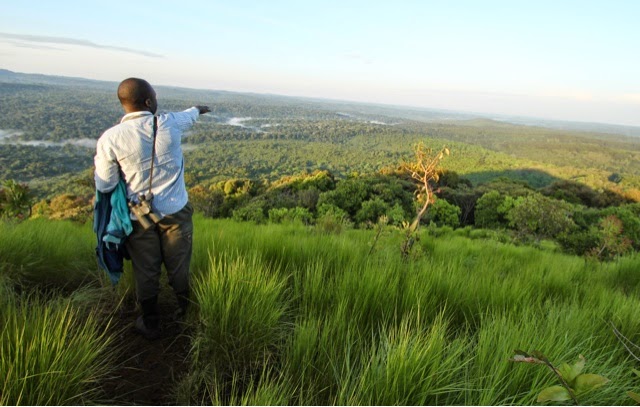
We woke up at 4:30 on Thursday in order to trek through the mud up to a hill overlooking the entire Kakamega rainforest. When we sat on top of that hill waiting for the sun to rise, the music created by the awaking birds and monkeys below was perhaps one of the only pleasant sounds I have heard in the last 4 weeks. It was quite impressive to look out over the tree canopies that stretched further than I could see. As the lover of the mountains that I am, I felt a sense of comfort sitting on that hill  that allowed me to look out over everything around me while watching the sun rise – this was perhaps the closest to home I have felt since arriving in Mumias. That feeling became a bit tainted 10 minutes later when our guide, Abraham, explained to us that this hill is coveted by the Luya tribe, as it is often where males are taken to be circumcised during their coming of age ceremony. Oh well, in the end our rainforest trip accomplished what it needed to: a quick break from our everyday routine and work here in Mumias! 


When we returned to our compound, I even had the chance to teach the other girls a yoga class! This was the first class I taught since receiving my teaching certification over a year ago. Although I’m sure it was a bit rusty, it seemed like everyone enjoyed the needed benefits of practicing a little yoga!


Tuesday, August 5, 2014

A Surprise-filled Visit to Mark's House

This Sunday was an eventful one. We've known for the past two weeks that we would be going to Mark’s house for lunch this Sunday, but I could not have expected what this experience would be like. 

Mark is a 21 year old college student from Mumias and has been interning with WOPLAH for the last 2 months for college credit from his university in Nairobi. Mark was one of the WOPLAH members who was waiting at our house the first night we arrived; from that moment he has been like a brother to us. Mark is often the one who shows up at our house in the morning to pick us up, he offers to carry our helmets (we decided to invest in some stylish red helmets to reduce our risk when riding boda bodas), and he ALWAYS makes sure we are “shiba’d” (full) at every meal – in fact, sometimes we get a little angry with him for not respecting when we are finished eating. Of course, we can never be too angry because we know he only does it out of a genuine interest in taking on our brotherly role. 

    ^Claire and I riding a boda boda. 

    ^ Mark!

   ^ Desi and the spilled milk. 

Sunday morning was an eventful one at our house. While our milk (which we get delivered to us fresh from the cow daily) was boiling, we heard a loud clamor in the kitchen. We went to see what happened only to find the milk all over the floor and a chicken darting out the door. No milk for us Sunday morning. Only seconds after the chicken incident, Libby somehow managed to shatter the glass lining of one of our canteens – now the floor was successfully covered in milk AND glass shards. We were all laughing hysterically at our obvious incompetence for cooking in Africa. Only seconds later, Steven, the landlord of the house we’re renting walked in to check up on us and see how everything was going. I only hope he didn’t hear all the yelling that was going on during our chaotic breakfast preparations, especially since the last time he showed up I was crying after just having seen a rat run across my bed. Steven most definitely thinks we’re crazy by now!

We travelled by van and  boda boda, followed by a beautiful walk  to get to Mark’s house. His family lives in a peaceful, isolated compound made up of 4 small houses and surrounded by touring trees. Before sitting down for tea Mark’s mother recited a long prayer for us and expressed her pride that we had come to visit her home. We then played a little frisbee with the confusingly large group of children hanging out in the compound. 

    ^Mark's family's compound. 

    ^ Playing frisbee with all the kids. 

Once the food was ready, Mark rounded up everyone to go inside the bigger of the 4 houses for introductions. One by one, he began introducing each of his family members; Mark has 11 brothers and sisters, most of which still live in his mother’s compound. Each time he finished introducing one, he would stop and say "and do you think there is another?" We would wait patiently for the next introduction; we always knew there must be more as we were crammed into a tiny house surrounded by kids of all ages. Our introduction to Mark’s siblings included multiple surprises. The first: his older brother Linus is one of our favorite regular boda boda drivers – Edwin, Mark and Linus all decided not to tell us the two were siblings this entire time! Second, we had already met three of Mark’s siblings the week before at a school we visited. He had  introduced himself and pretended not to know them during the visit just to surprise us. We thought we recognized those three kids from somewhere!

   ^ Us and all of Mark's siblings, mother and grandmother!

Third, Mark explained that his family has a kitchen garden and poultry project supported by WOPLAH! We didn’t know this either! Mark’s mother is HIV positive, and his father left over three years ago leaving her to care for all the children with no means to earn income. I could sense Mark’s pain as he told us their story, but the appreciation he expressed for WOPLAH and what they have done for his family was evident. I’m glad we have had the chance to get to know Mark during these few weeks and intern side by side with him!

    ^ Linus and the kitchen garden!

    ^ Linus and his daughter. 

    ^ One of the grandaughters in the compound. 

    ^ Another grandaughter in the compound!